Step into conflict

The sum total of all contentious topics, that SHOULD be brought to light but we steer around, could be called the conflict debt.

Overall, there will be more conflict – and less conflict debt – in teams with a high level of psychological safety. Psychological safety is the cultural foundation for saying what’s necessary without fear of retaliations from other members in the team.

Debt can come from “simple” conflicts, eg feedback to the colleague always speaking too loudly on the phone. Or more complicated problems: a meeting culture where the minds are elsewhere (next meeting, the mobile phone, the email needing an answer, …) Or, a tendency to talk about the problems with the wrong people, not the people they actually concern; we may not steer clear of the topic, but we avoid the opposition.

The opposition in a conflict is what feels like unpleasant friction. Friction occurs between people, not topics/areas/departments. Practice in stepping into conflict consists of habituation to the unpleasantness, very similar to the training you’ll be going through to overcome other avoidances or fear: exposure, exposure, exposure.

Constructive conflict habituation happens in a way where others are not harmed (of course!), and where the conflict is justified. The goal is to reduce conflict debt, NOT to turn the workplace into a battlefield.

As individuals, we can make an effort to improve culture in this important aspect. It’s good for the community, productivity and innovation, and our personal skills are strengthened.

Previously, I have suggested to question the foundation for statements presented as facts.

Here’s another exercise: explore an underexplored aspect.

Regardless of discussion topic, tunnel vision can develop, ie the tendency to see things from only one (typically, own) point of view. Suggest another angle, and try the discussion from there. Take your departure point in whatever you agree upon, but stretch agreement a little bit, eg: “Good plan. How do we also solve [….]”

Example: You agree to let job applicants know within two weeks, if they are invited to an interview. You say eg: ” That’s a good goal. How do we solve the situations where the time limit cannot be met?”

Or: Until now, your internal newsletter has been produced by each department taking turns, a practice you agree to change so marketing is the permanent writer. You say, eg: ”That simplifies the process a whole lot. How do we help marketing with information, so the newsletter remains interesting and relevant?”

Or: You agree, that the summer party should be planned by new hires. You say, eg: ” That’s a great way to get to know a lot of people. How do we handle the years where we have no new hires?”

As you internalize the structure – and keep focusing on the goal, which is to improve ideas, not kill them – it will be easier to step into, and remain in, conflict.

This exercise requires you to have a view of the missing perspective, and therefore it’s slightly more difficult than the previous one.

Structuring your training always drives the best result: you can practice in even-numbered weeks, or the first week of every month. Make a note of it!

Enjoy training 😊

Tug-of-war or hanging a tarp?

Engaging in conflict is often thought of as problem behavior to be avoided, especially in a workplace context.

We’re born into this world with a distaste for threats, our brains constantly scanning our environment to avoid or eliminate them. Since conflicts can be hard on relationships, and relationships in turn being something we crave for and need, conflicts can be understood as a threat. This perception continues to be passed on between generations, fuelled by every parent’s urge to train “good behaviors”: being nice to others, staying silent if you have nothing positive to say etc. In Scandinavia in particular, we are nice and polite and stay away from conflict if we can – our social coherence is strong, impacting our behavior quite forcefully.

However, in organizations, harmony is getting us nowhere. Conflict is a requirement for development and growth, and frequently even a foundational element in organizational design. Cross-functional teams have conflict – resolving different or opposed interests – as the main purpose.

In strategic sales pursuits, my primary workplace for the last few decades, a cross-functional team is mobilized to balance the interest of the client with the bidder’s risk profile, financial health etc. Clearly a delicate balance when stakes are high and executive leadership are watching closely. Conflict is perceived as detrimental to teamwork, but the opposite: aiming for harmony, shutting conflict down or letting it simmer under the carpets, may cause important issues to be left un-explored, stifling collaboration and business growth.

Conflict can be very unpleasant, not least when driven by bad behavior, poor performance or skills shortage. We may worry or even ruminate about conversations regarding such topics, and conflict aversion can then lead to conflict avoidance, ie simply not engaging in the conflict.

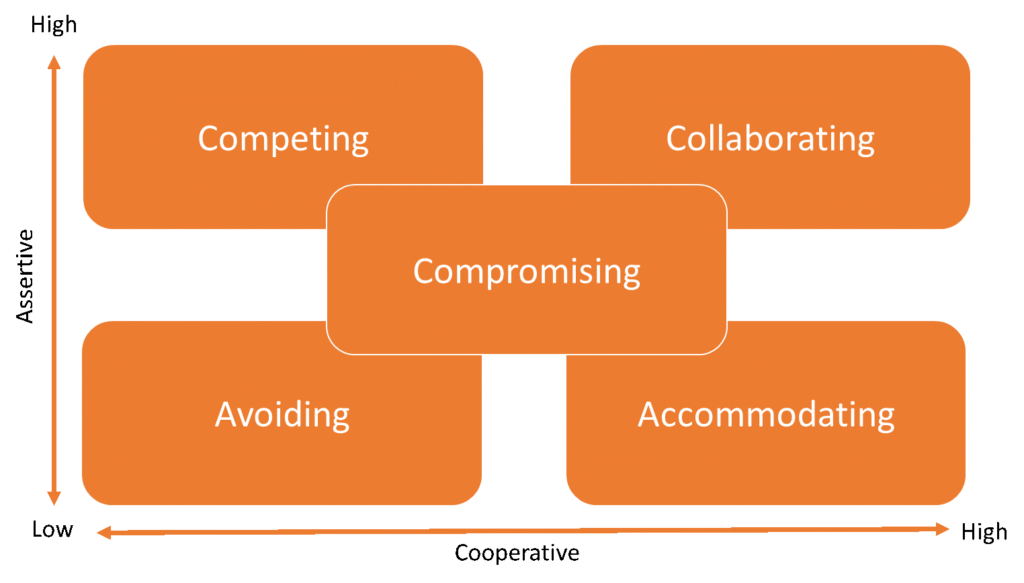
The Thomas-Kilmann Instrument shows conflict as an activity in two dimensions: whether any given approach meets your needs (level of assertiveness) and whether it also meets the other party’s needs (level of cooperative-ness).

Working to meet both sides’ needs is Collaborating, and to meet at least some of both side’s needs is Compromising. A compromise is not the best outcome but the quickest available option, as Chris Voss clearly illustrates in his book Never Split the Difference: a compromise between black and brown shoes is to wear one black and one brown, no swag at all!

Meeting your own need and not caring about the other side is Competing; meeting the needs of the other side without getting anything for yourself is Accommodating; and, finally, not trying to get anyone’s needs met is Avoiding.

Conflict avoidance makes no sense, not for you, not for them. Topics are circumvented and opportunity is drained. You change the subject, don’t call back, skip the meeting – whatever it takes to not face the conflict, making no room for the issue to be dealt with. Conflict-avoidance may buy you time, but it is unlikely to make the conflict disappear. Pressure will build, and the conflict can even grow larger when avoided.

But how to get through it then? Focus on the positive outcomes that awaits when the conflict is resolved. Your emotions will guide you, if you feel strongly about a conflict it’s a sign that it’s touching something important to you. Don’t let emotions take the steering wheel though! Stay calm, constructive and kind. Hard? Yes, but not as hard as it sounds.

A useful analogy: see conflict as a process like the one of hanging a tarp over your tent. A good result requires people pulling from each corner; if one corner pulls much harder than the other three, the tarp won’t hang properly.  It’s not a tug-of-war.

Following the Conflict Code, developed by Liane Davey in “The Good Fight”, you may prevent most conflicts and make the ones that are left, more productive and less taxing on your well-being. The model is a three-step approach: “Establish a line of communication”, “Create a connection” and “Contribute to a solution”.  Liane Davey includes a set of exercises to train how to enable proactive management of tensions and interdependencies in a cross-functional teams.

Conflict management is included in the half-day course “Teamwork in the Gig economy”, an event designed for leaders, project managers and teams wanting to improve collaboration, performance and respect. The event is introducing participants to foundational skills for contemporary working life – willpower, self-awareness, coaching, resilience, and can be tailored to fit actual needs in your team. More information here.